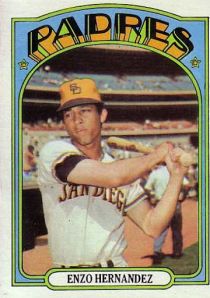
I was recently made aware of a record-tying season in 1971 by Enzo Hernandez, in which he drove in only 12 runs. Only one other regular player has driven in so few runs in a season, Goat Anderson in 1907. Enzo holds the record for fewest RBI with the most at-bats, and is also the only regular to accomplish this since the end of the dead-ball era.
Achievement of this unfortunate record does not rest entirely on Enzo’s shoulders. For one thing, RBIs are a team statistic - it is difficult to generate RBI without runners on base (unless you hit a lot of home runs). Hernandez and his teammates on the 1971 San Diego Padres managed an on-base percentage of just .293, lowest in the National League. As a testament to this, of Hernandez’s 549 at-bats for the season, only 160 came with men on base, and only 99 with runners in scoring position. Also, he was used almost exclusively as a lead-off hitter that season, so driving in runners was not his primary role. He was expected to score runs, and he did. Sort of. He scored 58 that year.
After reading about Hernandez’s season, I decided to look into what I will call Run Production Efficiency, which I define as the number of runs scored and driven in, per 100 plate appearances. This stat, I think, removes the “primary role” element, and focuses instead on how good the player was at producing runs for the team during his times at the plate.
Looking at individual seasons for regulars (minimum 350 plate appearances), here are the least efficient batters during the 1970’s:

Three of these players were catchers, which gives them a kind of “hall pass”. You could easily argue that the primary role of a catcher is defense, and if they produce anything at the plate you count it as a win.
A few of these players surprised me, as they regularly appear on team rosters in Retrotisserie Baseball. Probably not these particular seasons, however.